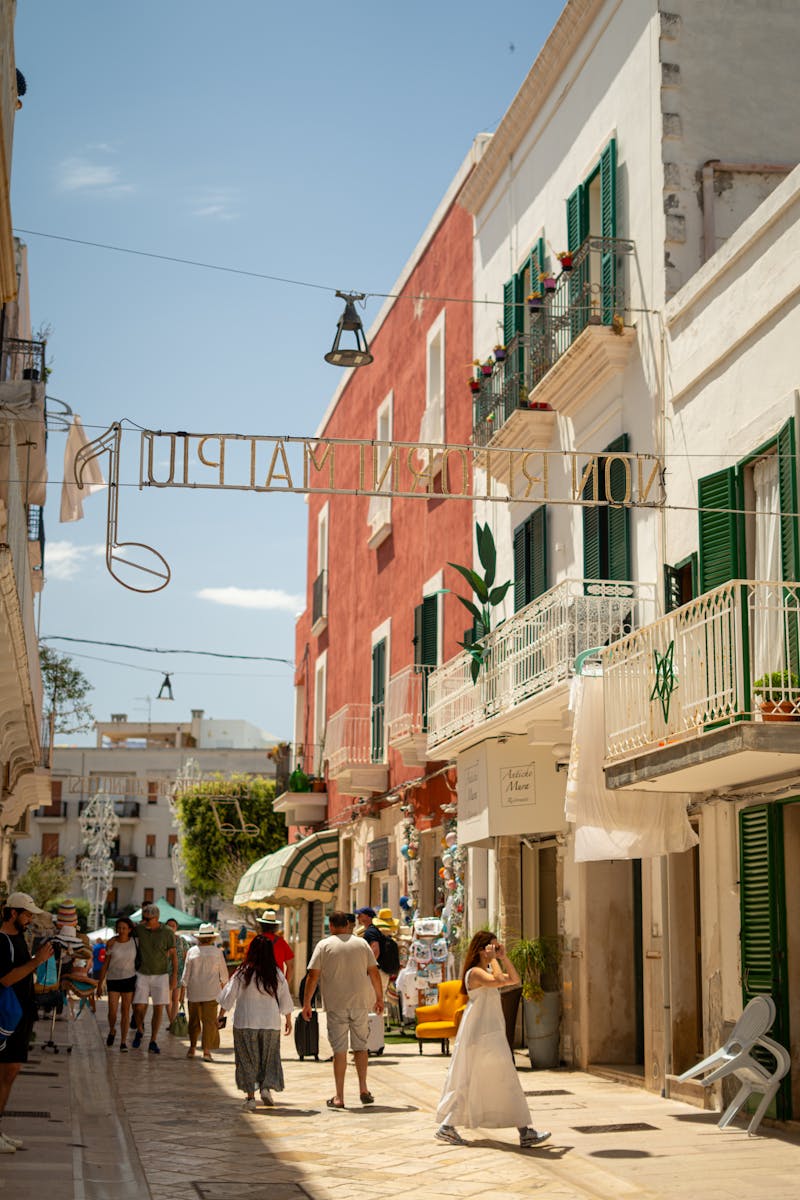
Bari is the heart of Apulia. The old town with its women making orecchiette in the streets, the most beautiful seafront in Italy and the Basilica of San Nicola make it a perfect base for exploring trulli, crystal-clear sea and masserie.
Bari's old town is a maze of alleys where life happens outdoors: women roll out orecchiette on tables in front of their homes along the Arco Basso, children play among lines of drying laundry, and the smell of fried fish drifts up from the old harbour. A few metres away everything changes: the nineteenth-century Murat district lines up shops, cafés and Liberty-style buildings on a grid of dead-straight streets. Two cities in one, separated by Corso Vittorio Emanuele II, plus a monumental seafront promenade running for kilometres between 1930s buildings and the open sea. Location does the rest: Polignano a Mare, Alberobello, Matera and the Salento are all under 2 hours away, which makes Bari the most convenient base for exploring Puglia.
📜 History at a glance
Bari began as a settlement of the Peucetians and later a Roman town (Barium), a staging post on the Via Traiana. The decisive moment came in the Middle Ages: after a short-lived Saracen emirate (847-871), the city became capital of the Byzantine catepanate, the part of southern Italy ruled from Constantinople. In 1071 it fell to the Normans of Robert Guiscard, and in 1087 sixty-two Bari sailors carried off the relics of St Nicholas from Myra, in Asia Minor: the Basilica was built to house them, a masterpiece of Apulian Romanesque and ever since a pilgrimage destination for the Orthodox world as well. Frederick II of Swabia rebuilt the castle in 1233. In the sixteenth century the Duchy of Bari flourished under Isabella of Aragon and Bona Sforza, the future queen of Poland. In 1813 Joachim Murat founded the new grid-plan district that still bears his name. The twentieth century brought the Fiera del Levante trade fair (1930) and the tragedy of 2 December 1943, when a German air raid on the harbour — the "little Pearl Harbor" — sank 17 Allied ships. Today Bari is the capital of Puglia and home to one of southern Italy's largest universities.
📅 Best time to visit
April-June and September-October are the best periods: 18-26°C, a sea warm enough for swimming from late May to early October, and a city you can comfortably walk at any hour. July and August are hot (30-34°C) and humid, but the sea makes up for it: around mid-August the city empties as locals migrate to the beaches further south. Winter is mild (10-14°C by day) and almost never drops below zero: December has the charm of the festive lights and the feast of St Nicholas on the 6th, with the old town in Christmas mode. To see Bari at its most alive, aim for the first ten days of May, when the patron saint's festival — historical procession and the statue carried out to sea — fills the streets; book accommodation well in advance.
Why visit Bari
Basilica di San Nicolathe old town and the orecchiette streetCathedral of San SabinoSwabian CastleLungomare Nazario SauroTeatro PetruzzelliTeatro MargheritaPiazza Mercantile and Piazza del FerraresePane e Pomodoro beachPolignano a MareAlberobelloMateraCastel del Monte
Basilica di San Nicola — Apulian Romanesque (1087-1197), free entry; the saint's relics lie in the crypt, venerated by Orthodox pilgrims too. Cathedral of San Sabino — Romanesque, 12th-13th century, with an archaeological crypt; on 21 June the setting sun aligns with the rose window. Swabian Castle (Castello Svevo) — Norman fortress rebuilt by Frederick II in 1233, moat and bastions, entry around €10. Orecchiette street (Arco Basso) — pasta makers work on their doorsteps, a daily and free spectacle. Teatro Petruzzelli — Italy's fourth-largest theatre (1903), destroyed by fire in 1991 and reopened in 2009; guided tours as well as the opera season. Teatro Margherita — a Liberty-style building raised on stilts over the water, now an exhibition space. Piazza Mercantile and Piazza del Ferrarese — the old town's evening living rooms, with the Column of Justice where debtors were once put on display. Lungomare Nazario Sauro — monumental, among the longest seafronts in Italy, at its best at dawn.
Suggested itineraries
1 day: morning at the Basilica di San Nicola, the Cathedral and the orecchiette street; lunch on focaccia or a panzerotto; afternoon at the Swabian Castle and a walk along the seafront; evening between Piazza Mercantile and the Ferrarese. 2-3 days: add Teatro Petruzzelli and Teatro Margherita, raw seafood at the San Nicola jetty, a swim at Pane e Pomodoro and half a day in Polignano a Mare (30 minutes by train), perhaps hopping on to Monopoli. 5+ days: Bari becomes your base for Puglia — Alberobello and the Itria Valley (Locorotondo, Martina Franca) on the Ferrovie del Sud Est or by car, Matera on the Ferrovie Appulo Lucane, Castel del Monte and Trani to the north, the Castellana Caves and Ostuni heading south.
🍽️ Local cuisine
Honest, working-class cooking. Orecchiette with cime di rapa (turnip tops) is the signature dish, followed by rice, potatoes and mussels (the oven-baked tiella) and spaghetti all'assassina, charred in an iron pan. Street food on every corner: fried panzerotto (€2-3), focaccia barese with cherry tomatoes and olives (€1.50-2 a slice, the historic Panificio Fiore near the Cathedral is the classic), sgagliozze (fried polenta) and popizze fritters. At the San Nicola jetty fishermen sell raw seafood: sea urchins, curled octopus, mussels opened on the spot. From nearby Andria comes burrata, best eaten ultra-fresh. Wines: Primitivo, Negroamaro, Castel del Monte DOC. Sweets: cartellate with vincotto at Christmas time, flaky sporcamuss pastries. Lunch in a trattoria €15-25, a fish dinner €35-55: the average quality is high and prices remain among the fairest in Italy.
Neighbourhoods to explore
Bari Vecchia: the old town on the peninsula between the two harbours — churches, workshops and street life; in the evening it fills up between Piazza Mercantile and Piazza del Ferrarese. Murat district: the nineteenth-century grid city, shopping on Via Sparano and Via Argiro, the most convenient choice for sleeping. Madonnella and the Lungomare Nazario Sauro: Liberty-style townhouses, the seafront promenade and the urban beach Pane e Pomodoro. Umbertino: elegant streets around the University and the station. Santo Spirito and San Girolamo: fishing villages and a regenerated waterfront to the north. Out of town: Polignano a Mare (30 minutes) for the cliffs, Alberobello (1 hour) for the trulli.
🎭 Events and festivals
7-9 May: Festa di San Nicola — historical procession in costume, the saint's statue carried out to sea, festive lights and fireworks: the event of the year. 6 December: winter feast of St Nicholas, with dawn rites in the Basilica and the city already in Christmas mood. March-April: BIF&ST, the Bari International Film Festival, screenings and guests between the Petruzzelli and the Teatro Margherita. Holy Week: solemn processions through the alleys of Bari Vecchia. September: Fiera del Levante (since 1930), the Mediterranean's historic trade fair. August: Bari Piano Festival, concerts at dawn and sunset in landmark locations around the city. January-February: 40 km away, the Carnival of Putignano, one of Europe's oldest, with its parade of allegorical floats.
How to get there
Bari Karol Wojtyła Airport (BRI) lies about 10 km north-west of the centre, at Palese. It is a base for Ryanair and Wizz Air, with easyJet, ITA Airways, Volotea and European legacy carriers (Lufthansa, Air France). From Italy: Milan (Linate, Malpensa, Bergamo) 1h20-1h30 €25-120, Rome Fiumicino 1h €35-110, plus direct flights from Turin, Venice, Bologna, Verona and Pisa. From Europe: London around 3h, Paris 2h30, Munich 1h40. The rail alternative: Frecciarossa and Frecciargento trains from Rome in about 4h (€30-70) and from Milan in 6h30-7h30 (€50-100), plus Intercity Notte sleepers. For the deep Salento it may be worth flying into Brindisi (BDS), 110 km to the south-east.
🚇 Getting around
The centre is walkable: Bari Vecchia is pedestrianised and the Murat district is flat and compact. AMTAB city buses cost €1 a ride (valid 90 minutes; €1.50 on board). From the airport: the Ferrotramviaria train to Bari Centrale in about 20 minutes (around €5), the Autobus Tempesta shuttle in 30 minutes (~€4), city bus AMTAB 16 (~€1, 40-45 minutes), or a fixed-fare taxi at around €25. For day trips: Trenitalia along the coast (Polignano €2.50-3 in 30 minutes, Monopoli 40 minutes), Ferrovie del Sud Est to Alberobello (about 1h40, ~€5) and Ferrovie Appulo Lucane to Matera (about 1h30, ~€6) — note that FSE and FAL cut back or suspend services on Sundays. A car is only needed for the Itria Valley and the masserie; in the centre there is a restricted traffic zone (ZTL) and parking is scarce.
Budget and prices
Return flight from Italy €25-120, from Europe €40-180 in low season. Sleeping: B&Bs and apartments in Bari Vecchia €50-90 a night, 3-star hotels in the Murat district €70-130 in low season and €110-190 in high, 4-star €120-220; tourist tax €1-4 per night. Eating: panzerotto €2-3, focaccia €1.50-2 a slice, trattoria lunch €15-25, fish dinner €35-55, espresso at the counter €1-1.20. Attractions: the Basilica is free and the Swabian Castle costs about €10; museum spending for 2-3 days runs €15-30 per person, a fraction of what the art cities of the North charge. Transport: buses €1, trains for day trips €2.50-6 each way. Weekend for two (flights excluded): €250-400 in low season, €400-650 in high.
📋 Practical info
Currency: euro. Language: Italian, with the Bari dialect everywhere; English is widely spoken in hotels and tourist-facing restaurants. Power sockets type F/L, 230V. Tap water is drinkable (Acquedotto Pugliese). Tipping is not expected: the €1.50-3 cover charge is already on the bill; round up if the service was good. Safety: Bari Vecchia is lived-in and busy until late; the usual big-city precautions apply — pickpockets are possible at the station and on crowded buses, and deserted streets are best avoided late at night. SIM and roaming: EU citizens pay no roaming surcharges; tourist eSIMs for everyone else. No visa for EU citizens, an identity card is enough. Bus tickets from tobacconists or via the AMTAB app.
💡 Practical tips
Rent a car only for the Itria Valley and the masserie: along the coast the train is more convenient and parking is never an issue.
A fried panzerotto in Bari Vecchia costs €2-3: eat it hot, straight out of the oil.
Focaccia from Panificio Fiore, the historic bakery near the Cathedral: the slice with cherry tomatoes is worth the queue.
Raw seafood at the San Nicola jetty early in the morning, with the fishermen: sea urchins and octopus just landed.
For Matera check the Ferrovie Appulo Lucane timetable: trains do not run on Sundays.
Ferries leave the port for Greece, Croatia, Albania and Montenegro.
The city itself is well covered in one full day, two at a relaxed pace. It makes sense, though, to stay 4-5 nights and use it as a base: Polignano, Monopoli, Alberobello and Matera are all feasible day trips by train, and in the evening you come back to dine in the old town.
The Ferrotramviaria train links the airport to Bari Centrale in about 20 minutes for around €5, with frequent departures. Alternatives: the Tempesta shuttle (30 minutes, ~€4), city bus 16 (slower but ~€1) or a fixed-fare taxi at around €25. Options thin out at night, so check the last departures.
Late spring and early autumn offer ideal weather and swimmable sea without the August crowds. If you want the soul of the city, aim for the patron saint's festival days in May; if you mainly want the beach, the water is warm from June to September. Winter brings mild temperatures and rock-bottom prices.
Bari is among the cheapest regional capitals in Italy: on €70-100 per person per day you can sleep in a B&B, eat very well and get around by train. Street food lowers the bill further: with focaccia and a panzerotto you can lunch for under €5.
In Bari Vecchia for atmosphere and nightlife, accepting alleys that stay lively until late; in the Murat district for comfort, shopping and proximity to the station — the best choice if you plan day trips. The seafront area around Madonnella combines quiet, sea views and Liberty-style townhouses at reasonable prices.
Yes: the old town, once given a wide berth, has been reclaimed and is now the tourist heart of the city, busy until late at night. Standard precautions still apply: watch for pickpockets at the station and on crowded buses, leave nothing visible in the car, and avoid poorly lit streets very late.
Beyond orecchiette, try spaghetti all'assassina, served charred straight from the iron pan, and the tiella of rice, potatoes and mussels. For breakfast, focaccia fresh from the oven; as a snack, sgagliozze fried in the street. Raw-fish lovers will find sea urchins and octopus at the jetty at fishermen's prices.
This site uses third-party cookies — Google Analytics for visit statistics and functional cookies for the flight search engine. By clicking "Accept" you consent to the use of cookies. Cookie policy