🇵🇱
Flights and Hotels in Krakow
Krakow is Poland's gem. The perfectly preserved medieval old town, Europe's largest market square and incredibly cheap yet vibrant nightlife make it one of Europe's best value destinations.
Krakow is Poland's gem. The perfectly preserved medieval old town, Europe's largest market square and incredibly cheap yet vibrant nightlife make it one of Europe's best value destinations.
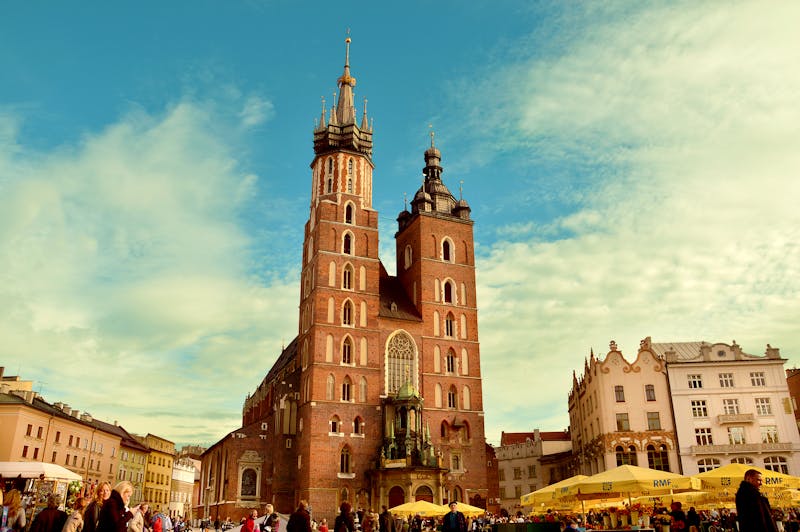
Kraków is easy to explore on foot: Rynek Główny, Wawel and Kazimierz form a compact triangle, although museums and day trips require time. Two days cover the Old Town and former Jewish quarter; three or four allow for Podgórze, Schindler’s Factory and either Wieliczka or Auschwitz-Birkenau. Cellars in the centre host jazz clubs and bars, while Kazimierz’s courtyards concentrate cafés and nightlife. Nowa Huta instead reveals post-war socialist planning. Costs are generally lower than in many Western European capitals, but affordability should never turn places of remembrance into casual attractions: Auschwitz requires preparation, respect and at least half a day.
Developed around Wawel Hill and documented as an important medieval trading centre, Kraków became the capital of the Kingdom of Poland and the setting for royal coronations. In 1364 Casimir III founded the Kraków Academy, now Jagiellonian University, among Central Europe’s oldest universities. The main square, Wawel Castle and Gothic churches reflect the period when the city was a political and commercial hub. After the court moved to Warsaw, Kraków retained a powerful cultural and symbolic role. The partitions of Poland brought it under Habsburg rule; in the twentieth century it endured Nazi occupation, the creation of the ghetto in Podgórze and the deportation of its Jewish community. Nearby Auschwitz-Birkenau bears witness to Nazi extermination. After the war, the socialist industrial town of Nowa Huta was built and later absorbed into Kraków. The historic centre, Kazimierz and Wawel are now essential for understanding the city’s continuities, destruction and recovery.
May to September brings long days and the best temperatures for sightseeing, but July and August also mean crowds, higher prices and occasional storms. May, June and September usually offer the soundest balance. April and October are cool and changeable, with fewer visitors. Winter is cold, often close to or below freezing, so footwear suitable for snow or ice matters; December attracts travellers to the market on Rynek Główny. The colder season suits museums, cafés and concerts but provides fewer daylight hours. Book Auschwitz-Birkenau and Wieliczka in every season. Easter and European holiday weekends push up occupancy and rates, so always check the events calendar before choosing dates.
Rynek Główny — vast medieval square with the Cloth Hall, Town Hall Tower and entrance to the underground museum. St Mary’s Basilica — Gothic church known for Veit Stoss’s altarpiece and the trumpet call from its tower. Wawel — royal castle, cathedral and courtyards above the Vistula; sections require separate admission. Planty — green ring laid out where the walls once stood. Collegium Maius — historic heart of Jagiellonian University. Kazimierz — synagogues, cemeteries and Jewish heritage alongside lively nightlife. Podgórze — Ghetto Heroes Square and wall fragments evoke the occupation. Schindler’s Factory — historical museum about wartime Kraków; reserve ahead. Wieliczka — underground route through salt chambers and chapels. Auschwitz-Birkenau — memorial outside the city, an emotionally demanding visit requiring respect.
1 day: follow Planty to Rynek Główny, the Cloth Hall and St Mary’s; walk down the Royal Route to Wawel and finish in Kazimierz among synagogues and Plac Nowy. 2-3 days: spend day two in Podgórze at Ghetto Heroes Square and Schindler’s Factory, leaving adequate museum time; on day three choose Wieliczka or Auschwitz-Birkenau rather than squeezing both into one half-day. 5+ days: add Collegium Maius, the Rynek Underground and Czartoryski museums, a Vistula walk and half a day in Nowa Huta. With more time, visit Kościuszko Mound or explore neighbourhoods beyond the centre. Reserve the most popular sites and alternate historically heavy visits with walks and breaks.
Local cooking is filling and suited to the climate. Pierogi are boiled or pan-fried dumplings filled with potato and cheese, meat, cabbage or fruit. Żurek is a sour fermented rye soup, often served with egg and sausage. Obwarzanek krakowski is a ring-shaped boiled and baked bread sold at street stands. Zapiekanka is half a baguette grilled with mushrooms, cheese and toppings, especially associated with Plac Nowy. Also try bigos, barszcz, gołąbki and sausages; desserts include sernik and szarlotka. Milk bars serve simple food cheaply, while Kazimierz has contemporary Polish and Jewish restaurants. A budget breakfast is about PLN 20-35, a simple lunch PLN 30-55 and a mid-range dinner PLN 70-120 per person. Vodka is traditional but best enjoyed moderately; water is always the sensible alternative.
Stare Miasto contains Rynek, museums and monuments: exceptionally convenient, busy and more expensive. Kazimierz combines synagogues, memory and nightlife; it can be noisy, so choose accommodation carefully. Stradom, between Kazimierz and Wawel, is practical for walking. Podgórze, across the Vistula, offers Schindler’s museum, post-industrial spaces and a more residential pace. Grzegórzki is well connected and often cheaper than the centre. Nowa Huta deserves a visit for its avenues, squares and socialist architecture but lies away from the main sights. For a first stay, Stare Miasto or Kazimierz minimises travel; those seeking quiet can consider Salwator or the edges of the centre.
Easter brings religious traditions and a seasonal market to the centre. Juwenalia fills the university city with student events in spring. The annual Kraków Film Festival focuses on documentaries and short films. Wianki, around the summer solstice, combines concerts by the Vistula with the wreath tradition. The Jewish Culture Festival presents talks, music and activities mainly in Kazimierz, with a changing programme. Autumn music and literary festivals use historic halls and contemporary spaces. All Saints’ Day fills cemeteries with thousands of candles and is a lived commemoration, not a tourist show. December brings the Christmas market to Rynek Główny and the szopki competition devoted to Kraków’s elaborate nativity scenes. For major events, reserve accommodation early and check road closures.
John Paul II Kraków-Balice International Airport KRK is roughly 11 km from the centre. Several Italian cities normally have direct services, especially with Ryanair, Wizz Air and, depending on route and season, network airlines; a nonstop flight from Milan, Rome, Venice or Bologna takes approximately 1 hour 45 minutes to 2 hours 15 minutes. Frequencies and departure airports change during the year, so compare baggage and transfers rather than the headline fare alone. Katowice KTW can be an alternative for some low-cost routes but is much farther away and needs an additional transfer; it only makes sense for a substantial net saving. Trains are useful for onward travel to Warsaw, Wrocław and other Polish cities.
The centre is walkable; for longer distances the KMK network combines trams and buses, using validated time-based tickets and fare zones. A short journey costs roughly PLN 4-9 depending on validity, while one- and multi-day passes start near PLN 20. Apps and ticket machines help identify the correct ticket. From KRK airport, Koleje Małopolskie’s SKA1 train links the terminal, Kraków Główny and Wieliczka: allow around 20 minutes and PLN 20 to the main station. City buses are a slower alternative; check the route and zone on the day. Official taxis and app-based cars usually take 25-40 minutes depending on traffic and cost about PLN 80-130. Buses and tours serve Auschwitz; SKA1 also reaches Wieliczka. A car is unnecessary in the centre and parking is restricted.
The currency is the złoty and costs vary sharply by weekend, summer and December demand. Accommodation: a hostel bed starts around PLN 70-130; a budget double costs about PLN 220-380, a good mid-range hotel PLN 350-650, with upscale properties higher. Food: a milk bar meal or snack costs PLN 20-40, a simple lunch PLN 35-60 and a mid-range dinner PLN 70-120 per person; alcohol and main-square venues increase the bill. Transport: allow PLN 20-55 for one- to three-day urban passes and about PLN 40 for a return airport train. Museums and trips are the larger variable: Auschwitz with transfer or guide and Wieliczka can each cost several dozen to over one hundred złoty. A careful traveller spends roughly PLN 220-350 daily excluding accommodation; mid-range is PLN 400-650, plus flights.
The currency is the Polish złoty (PLN, zł); cards are widespread, although small cash is useful at stalls. Polish is the local language and English is common in visitor services. Sockets are type C and E, 230V. Tap water is generally safe to drink. EU citizens normally need a valid travel document but no visa for a short stay under current rules; Poland is in the Schengen Area. EU roaming applies subject to your plan. Tipping is optional: around 10% can be left for good restaurant service after checking it is not included. Kraków is broadly safe, but watch bags and avoid poor exchange rates or venues with unclear pricing. Grip footwear helps in winter. Maintain respectful behaviour and clothing at memorial sites.
This site uses third-party cookies — Google Analytics for visit statistics and functional cookies for the flight search engine. By clicking "Accept" you consent to the use of cookies. Cookie policy