🇮🇪
Flights and Hotels in Dublin
Lively and welcoming, Dublin offers historic pubs with live music, the legendary Guinness Storehouse and a unique literary heritage.
Lively and welcoming, Dublin offers historic pubs with live music, the legendary Guinness Storehouse and a unique literary heritage.
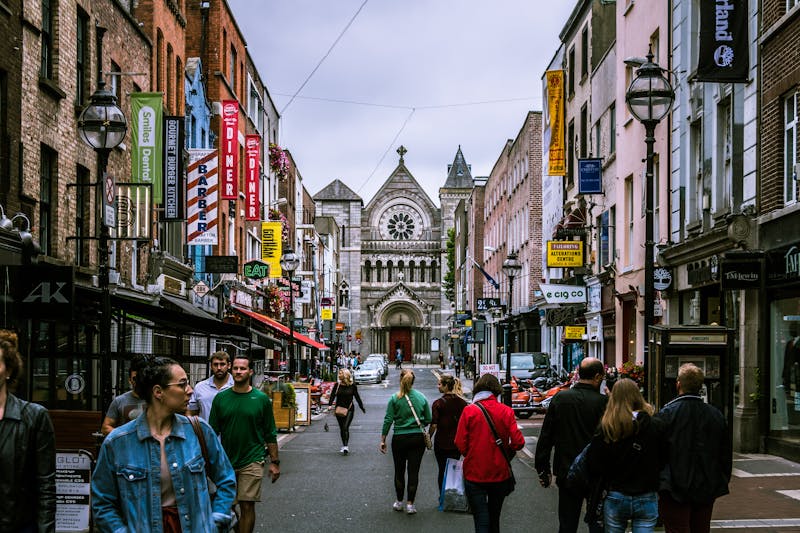
Dublin is compact at its centre, but major attractions spread between Trinity College, the Liberties, Kilmainham and Phoenix Park. Two days cover the historic core and one major museum; three allow for the Guinness Storehouse, Kilmainham Gaol and districts beyond Temple Bar; with four or five, add the DART coast. The city’s literary identity is tied to Jonathan Swift, Oscar Wilde, W. B. Yeats, James Joyce and Samuel Beckett, yet it is also a contemporary university and technology centre. Pubs are social places, not merely drinking stops: the best traditional music is not always in the most touristy district. Howth provides a harbour, seafood and coastal paths; day trips to the Cliffs of Moher or Giant’s Causeway are possible but long and take time away from Dublin itself.
Earlier settlements existed along the Liffey, but the ninth-century Viking port of Dyflin decisively shaped the city’s growth. After the Anglo-Norman conquest, Dublin became the administrative centre of English power in Ireland. The castle housed government for centuries, while Trinity College was founded at the end of the sixteenth century. The city prospered in the eighteenth century, acquiring Georgian squares and houses, then lost political importance after the Act of Union moved parliament to London. The Great Famine transformed the island and fuelled emigration and urban poverty. Irish nationalism culminated in the Easter Rising, War of Independence and establishment of the Irish Free State; many Dublin sites retain traces of those conflicts. During the twentieth century, the capital expanded beyond its centre. Docklands regeneration, international investment and cultural growth reshaped the economy, while literature, music and political memory remain central to its identity.
May to September brings long days and the mildest temperatures, but Atlantic weather remains changeable: sunshine, wind and rain can alternate quickly. May, June and September often provide the best balance of light and visitor numbers. July and August are lively, expensive and in high demand. March attracts visitors for the St Patrick’s Festival; hotels and flights rise in price and the centre becomes crowded, so reserve early. October can be rewarding for museums, pubs and cultural festivals. November to February is short, damp and windy, though rarely extreme; indoor attractions are quieter. Carry a light waterproof in every season. For Howth or a coastal outing, choose the most stable day and do not build your schedule around forecasts issued too far ahead.
Trinity College — historic campus containing the Book of Kells and Long Room; timed admission should be booked. Dublin Castle — State Apartments, courtyards and traces of the medieval city. Christ Church Cathedral — cathedral with a large crypt and links to Viking Dublin. St Patrick’s Cathedral — national cathedral associated with Jonathan Swift. National Museum, Archaeology — prehistoric and medieval Irish treasures, normally free. Kilmainham Gaol — former prison central to independence history; tours sell out early. Guinness Storehouse — exhibition about the beer and brand at St James’s Gate. EPIC — interactive emigration museum in the Docklands. Phoenix Park — extensive urban park with broad avenues and official residences. Howth — harbour village reached by DART, offering seafood and weather-exposed coastal walks.
1 day: start at Trinity College and the Book of Kells, cross Grafton Street and St Stephen’s Green, visit the National Museum, then continue to Dublin Castle, Christ Church and the Liffey; finish in a pub beyond Temple Bar’s busiest stretch. 2-3 days: on the second, visit pre-booked Kilmainham Gaol, the Guinness Storehouse and the Liberties; on the third choose EPIC and Docklands, or Phoenix Park, Smithfield and Stoneybatter. 5+ days: add the National Gallery, literary museums, Glasnevin Cemetery and Botanic Gardens. Use one day for the DART to Howth, Dún Laoghaire, Dalkey or Bray depending on the weather. For longer trips, Belfast by train is more logical than compressing Ireland’s west coast and Dublin into the same day.
Dublin food combines home cooking, island produce and modern restaurants. A full Irish breakfast includes some combination of eggs, bacon, sausages, pudding, tomato, mushrooms and bread, often enough until afternoon. Try lamb or mutton Irish stew, Dublin coddle with sausage and potato, seafood chowder, fish and chips and soda bread with butter. Howth suits fish and shellfish; pubs serve pies, stews and roasts. Desserts include apple tart, bread-and-butter pudding and whiskey-flavoured dishes. Guinness is the signature stout, although the city also has craft breweries and distilleries. Breakfast or a quick lunch costs around €10-18, a pub meal €16-25 and a mid-range dinner €30-50 per person. Temple Bar often charges more; the Liberties, Stoneybatter, Capel Street and Portobello offer greater variety. In pubs, customers commonly order and pay at the bar.
Trinity and Grafton Street are central, convenient and expensive, close to museums and Georgian parks. Temple Bar concentrates nightlife and visitors: useful for one evening, noisy and rarely good value for sleeping or drinking. The Liberties contains the Guinness Storehouse, distilleries and long-established working neighbourhoods. Smithfield and Stoneybatter have local pubs, cafés and Luas links, with a less visitor-focused atmosphere. Portobello and Rathmines suit brunch, restaurants and residential stays, accessible on foot or by bus. Docklands displays contemporary Dublin and contains EPIC, offices and modern hotels. Howth is a coastal village, not a practical base for daily city sightseeing. On a first stay choose Dublin 2, the Liberties or Smithfield according to budget and noise tolerance.
The St Patrick’s Festival around 17 March brings parades, performances and huge crowds; it is a national celebration, not merely a night in pubs. Bloomsday on 16 June follows the places and characters of James Joyce’s Ulysses through readings and period dress. Summer brings concerts, literary events and outdoor festivals. The Dublin Fringe Festival presents contemporary performance, while the Dublin Theatre Festival stages Irish and international work in autumn. Easter Rising commemorations have civic and historical significance. The Bram Stoker Festival recalls Dracula’s author through autumn events. At year end, lights, concerts and New Year programmes animate the centre. Dates and content vary: secure accommodation early for St Patrick’s and major matches, and check bus diversions or road closures.
Dublin Airport DUB lies north of the centre and is the Republic of Ireland’s main airport. Numerous nonstop services normally operate from Italy, particularly with Ryanair and Aer Lingus, plus seasonal or network airlines according to airport; from Milan, Rome, Venice, Bologna or Naples, flying time is approximately 2 hours 45 minutes to 3 hours 30 minutes. Fares rise around St Patrick’s Day, summer and weekends, so compare baggage and bus timing rather than the base price alone. The airport has no direct railway station. Belfast International BFS and Belfast City BHD require an intercity transfer and are inefficient alternatives for a short Dublin stay. For onward travel around Ireland, Connolly mainly serves north and east, while Heuston handles west and south.
The centre is walkable; for longer distances TFI coordinates Dublin Bus, Go-Ahead, Luas trams, DART and commuter trains. The Leap Card provides integrated fares: the TFI 90 Minute Fare is roughly €2 for many transfers within ninety minutes; touch the card whenever required on each mode. DART follows the coast from Howth or Malahide towards Dún Laoghaire, Bray and Greystones. From DUB airport there is no train: urban routes 19 and 41 are economical, while Dublin Express and Aircoach run direct coaches to several central stops. Allow approximately 30-60 minutes and €2-3 for the city bus with the appropriate ticket, or €8-12 for a coach; traffic can lengthen trips. Official taxis generally take 25-45 minutes and cost around €25-40. Luas has red and green lines; neither currently reaches the airport. A car is unnecessary centrally.
Dublin is among Europe’s most expensive cities for accommodation. Stays: a hostel bed costs around €35-70, a budget double €110-180 and a mid-range hotel €160-280; weekends and major events push rates much higher. Food: breakfast or snack €7-14, quick lunch €10-18, pub meal €16-25 and mid-range dinner €30-50 per person; a central pint is roughly €6-9. Transport: around €2 for many integrated Leap journeys and €8-12 for an airport coach; central visitors walk frequently. Trinity, Guinness, Kilmainham and EPIC can bring three-day admission costs to €70-120, while the National Museum and National Gallery offer free alternatives. Excluding accommodation, budget €60-90 per day carefully or €110-170 mid-range. Booking a cancellable hotel rate far ahead is often the largest saving.
The currency is the euro. Irish and English are official languages; English dominates daily life, while signs are often bilingual. Sockets are type G, 230V, so Italian visitors need an adapter. Tap water is generally safe to drink. Ireland belongs to the EU but not the Schengen Area; EU citizens can normally enter with a valid document under current rules and do not need a visa for short visits. EU roaming applies according to the plan. Tipping is optional: 10-12.5% is common in restaurants when service is not included; no percentage is expected for bar service. Dublin is generally safe, but watch phones and bags in crowds and avoid heavily intoxicated groups at night. Look both ways when crossing because traffic drives on the left. A waterproof jacket works better than an umbrella in wind.
This site uses third-party cookies — Google Analytics for visit statistics and functional cookies for the flight search engine. By clicking "Accept" you consent to the use of cookies. Cookie policy