🇲🇻
Flights and Hotels in Maldives
An archipelago of 1,200 coral islands in the Indian Ocean where the sea has impossible turquoise shades and resorts offer postcard overwater bungalows.
An archipelago of 1,200 coral islands in the Indian Ocean where the sea has impossible turquoise shades and resorts offer postcard overwater bungalows.
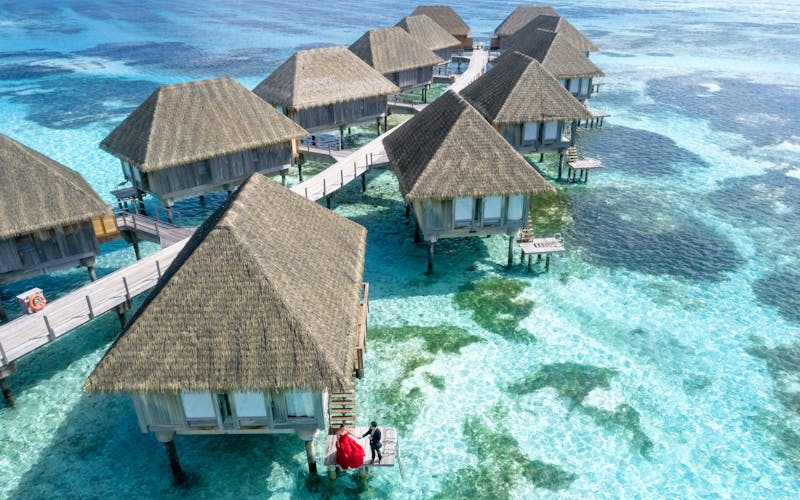
The Maldives are 1,200 coral islands scattered across 26 atolls in the Indian Ocean, with a sea in almost unreal shades of turquoise and blue. Hardly any land rises more than two metres above the water: everything here revolves around the ocean. The resorts — one per island, more than 160 in all — offer overwater bungalows and a discreet kind of luxury where time is set only by the tides. But the Maldives are also a real country: since 2010, guesthouses on inhabited islands such as Maafushi and Thulusdhoo let you sleep from around €50 a night and experience the archipelago alongside Maldivians. The basic choice is between a secluded resort and a local island; either way, there is snorkelling with mantas, whale sharks and coral reefs everywhere.
The archipelago was settled more than two thousand years ago by peoples from Sri Lanka and southern India; the Dhivehi language, written right to left in the Thaana script, preserves those roots. For centuries the Maldives were a Buddhist kingdom, until the ruler converted to Islam in 1153 — still the state religion today. The sultanate prospered by exporting cowrie shells — used as currency from Asia to Africa — along with dried fish and coconut fibre. In 1558 the Portuguese occupied Malé, but in 1573 they were driven out by Muhammad Thakurufaanu, the national hero celebrated on National Day. A British protectorate from 1887, with an RAF base at Gan (Addu Atoll), the country gained independence on 26 July 1965 and became a republic in 1968. Tourism was born in 1972 with the first resort, Kurumba Village, on a coconut island north of Malé: today it is by far the country's leading industry. The 2004 tsunami and the rising ocean — 80% of the land sits less than a metre above the water — remain the challenges of a state that literally lives on the sea.
The dry season runs from November to April, with the north-east monsoon (iruvai): clear skies, calm seas and excellent visibility for snorkelling. January to March is the best period of all — and the most expensive, peaking at Christmas and New Year. From May to October the south-west monsoon (hulhangu) blows: short but heavy showers, rougher seas and prices down by as much as 30-40%; June and September remain reasonable bets. The temperature never changes: 28-31°C all year round, with the water at 27-29°C. The wet monsoon has one advantage: plankton draws the mantas to Hanifaru Bay (Baa Atoll) between June and November. The whale sharks of Ari Atoll, meanwhile, are there all year.
Malé — one of the world's most densely populated capitals: the Hukuru Miskiy mosque in carved coral stone (1658), the gold-domed Islamic Centre, the fish market on the waterfront. South Ari Atoll — whale sharks patrol the Maamigili reef all year round, a marine protected area. Baa Atoll — a UNESCO Biosphere Reserve since 2011; at Hanifaru Bay, dozens of mantas gather between June and November. Maafushi — the local island that invented guesthouse tourism, 27 km from Malé. Thulusdhoo — the surf capital, home of the Cokes wave. Vaadhoo — famous for plankton bioluminescence on moonless nights. Utheemu — Thakurufaanu's timber palace, in the far north. Addu Atoll — the far south of the archipelago, with the WWII British base at Gan and islands linked by a cycling causeway. Fuvahmulah — a one-island atoll and a prime destination for tiger shark diving.
1 day (a long layover in Malé): the Hukuru Miskiy mosque, the fish market and the Islamic Centre in 2-3 hours, then the ferry to Hulhumalé or a trip to a nearby sandbank. 2-3 days: base yourself on Maafushi or Thulusdhoo with a package of excursions — reef snorkelling, a sandbank picnic, swimming with turtles, a sunset dhoni trip for dolphins. 5+ days: the classic formula is a week at a resort with a seaplane transfer, or the combination of a local island (3-4 nights) plus a resort (2-3 nights) to balance price and luxury; alternatively, a 7-night safari-boat cruise between Malé, Ari and Baa covers the archipelago's best dive sites. With a 9-hour flight, anything under 5 nights on the ground pays off poorly.
Fish — above all pole-and-line tuna — rules every table. The Maldivian breakfast is mas huni: shredded tuna with grated coconut, onion and lime, scooped up with roshi, the local flatbread. Garudhiya is a clear fish broth served with rice, lime and chilli; fish or chicken curry accompanies almost every meal. In the local tea houses (sai hotaa) you graze on hedhika, the snacks known as short eats: gulha (fish and coconut dumplings), bajiya, masroshi and samosas, at a few rufiyaa apiece. Desserts lean on coconut and sago; fruit means papaya, mango, banana and fresh coconut. In the resorts the register changes: high-level international cuisine, Japanese and Mediterranean restaurants, dinners at the water's edge and serious wine lists — alcohol, by law, exists only there. On local islands you eat for $3-8; at a resort a meal easily tops $30-50.
The North and South Malé atolls hold the most accessible resorts: speedboat transfers of 20-60 minutes, with no seaplane costs. Ari Atoll is the choice for those travelling for mantas and whale sharks, with long-established resorts and local islands such as Dhigurah. Baa Atoll, a UNESCO Biosphere Reserve, combines high-end resorts with extraordinary biodiversity. The local islands — Maafushi, Thulusdhoo, Fulidhoo, Dhigurah — are the budget Maldives of the guesthouses. Hulhumalé, the artificial island next to the airport, works for a first or last night. Addu Atoll, in the far south, is for returning visitors looking for an archipelago away from the usual routes.
The calendar follows Islam and the seasons of the sea. During Ramadan (a lunar month, movable dates) the cafés on local islands stay closed by day; the resorts are unaffected. Kuda Eid ends the fast, while Bodu Eid (Eid al-Adha) is the most heartfelt festival: on local islands there are water games, dances and bodu beru drums. On 26 July, Independence Day, Malé fills with parades; 11 November is Republic Day, 3 November Victory Day. National Day (the first of Rabi al-Awwal) celebrates Thakurufaanu's victory over the Portuguese. In nature: mantas at Hanifaru Bay from June to November, surf on the Thulusdhoo waves from April to October.
All international flights land at Velana International (MLE), on the island of Hulhulé, linked to Malé by the Sinamalé Bridge. From Italy there are seasonal direct flights, concentrated in the dry season: Neos from Milan Malpensa (and in some seasons from Verona and Rome) and ITA Airways from Rome Fiumicino, with 8h45-9h30 in the air and return fares from around €600-700 in low season up to €1,200-1,500 around Christmas. With a stopover you can fly all year: Emirates via Dubai, Qatar Airways via Doha, Etihad via Abu Dhabi and Turkish Airlines via Istanbul — 12-16 hours in total, often €100-200 less than the non-stop. From Velana you continue to the resorts by seaplane, speedboat or domestic flight.
In the Maldives you move by sea or by air. The seaplanes of Trans Maldivian Airways — the world's largest fleet — serve the more distant resorts: daylight only, around $300-500 return per person, booked through the resort. Speedboats cover the North and South Malé atolls and nearby islands: $50-250 return. Domestic flights with Maldivian, Manta Air and FlyMe reach the regional airports (Dharavandhoo for Baa, Maamigili for South Ari, Gan for Addu), with a dhoni or boat for the final leg. The MTCC public ferries are the $1-3 option to the local islands: slow (Malé-Maafushi about 90 minutes), not daily on every route and never on Fridays. Airport to Malé: bus or taxi across the bridge in 10-15 minutes, for a few rufiyaa. Malé itself is walkable.
Return flight from Italy €600-900 in low season, €900-1,500 between December and March. Per night: guesthouses on local islands €50-100; four-star resorts $250-500 on half board; five-star overwater villas from $700-800 upwards, with no ceiling. On top of resort prices come the 10% service charge, the tax on tourism services and a green tax of a few dollars per person per night: the final bill grows by about a quarter. Meals: $3-8 in local cafés, $25-60 per person in resort restaurants — which is why half board or all-inclusive makes sense. Transfers: from $50 (nearby speedboat) to $500 (seaplane) per person return. Total for a week as a couple, flights excluded: €1,500-2,500 on local islands, $4,000-8,000 and beyond at a resort.
Currency: the rufiyaa (MVR), but the US dollar is accepted everywhere and resorts price in USD; cards work at resorts and many guesthouses. Visa: free for 30 days on arrival, plus the online Imuga declaration within 96 hours before travel. Language: Dhivehi; English is spoken almost everywhere. Sockets: type G (British), 230 V — you need an adapter. Tap water is not drinkable: bottled water or the resorts' desalinated supply. A very safe country, with minimal crime. Tipping: the 10% service charge is already on the bill; a few dollars for staff are appreciated. Tourist SIMs from Dhiraagu and Ooredoo at the airport, around $30-50 with plenty of data. On local islands cover shoulders and knees, bikini only on the bikini beaches; no alcohol outside the resorts, not even in your suitcase. Time: 4 hours ahead of Central Europe (3 in summer).
This site uses third-party cookies — Google Analytics for visit statistics and functional cookies for the flight search engine. By clicking "Accept" you consent to the use of cookies. Cookie policy