🇦🇹
Flights and Hotels in Vienna
Imperial capital of music, Vienna enchants with Habsburg palaces, historic cafés and one of Europe's richest cultural scenes.
Imperial capital of music, Vienna enchants with Habsburg palaces, historic cafés and one of Europe's richest cultural scenes.
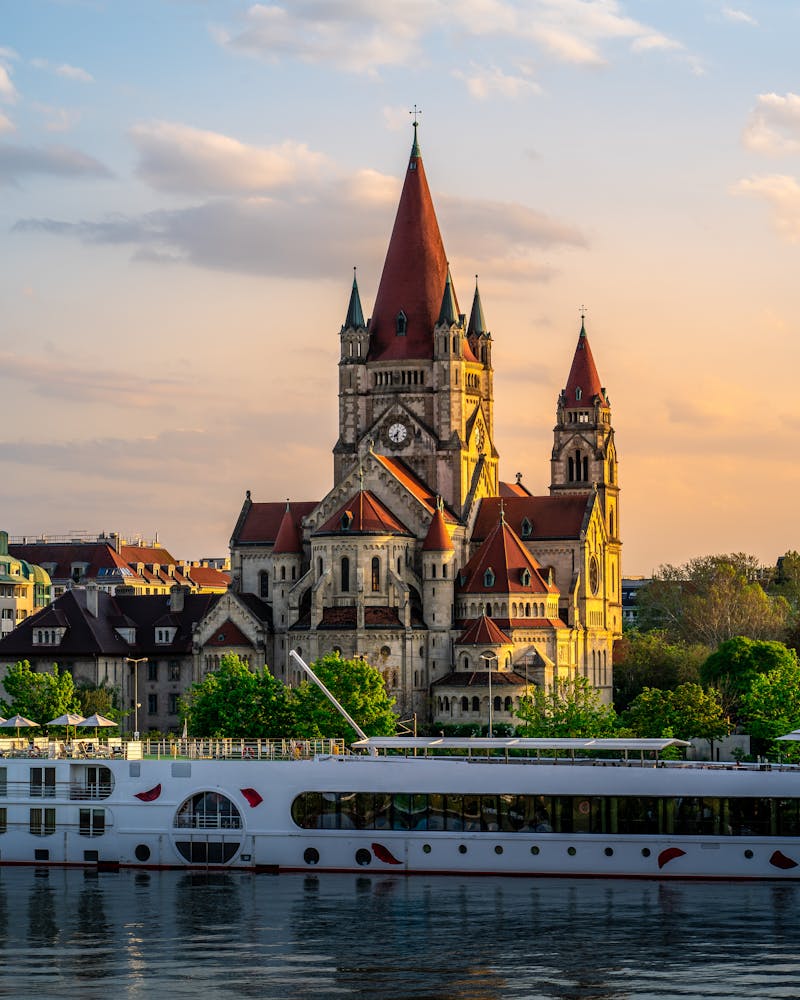
Vienna involves greater distances than its compact centre suggests: the Ring is walkable, while Schönbrunn, Belvedere, the Prater and wine districts require metro, tram or urban train. Three days cover the Hofburg, Stephansdom, one major museum and Schönbrunn; four or five allow time for historic coffee houses, concerts and residential neighbourhoods without rushing. Habsburg heritage coexists with social housing, design, markets and contemporary spaces. Museums are substantial and often close together: choosing one per half-day is more realistic than accumulating entries. In the evening, the Danube and Donaukanal reveal an informal side, while the outskirts of Grinzing and Neustift retain the Heuriger taverns of Viennese wine culture.
Vienna began as the Roman camp of Vindobona on the Danube and became a medieval residence of the Babenbergs, then the Habsburgs. From the fifteenth century it was the political centre of a dynasty governing broad European territories. It resisted Ottoman sieges in 1529 and 1683; after the second, a Baroque city expanded through aristocratic palaces and churches. In the eighteenth century Maria Theresa and Joseph II reformed administration, education and cultural life. Haydn, Mozart, Beethoven and Schubert linked Vienna to music history. The Congress of Vienna redrew Europe after Napoleon. In the nineteenth century Franz Joseph ordered the walls removed and the Ringstrasse built, while Vienna grew as the multiethnic Austro-Hungarian capital. Klimt, Schiele, Freud and Secession architects defined fin-de-siècle Vienna. After the First World War it became capital of a small republic and developed “Red Vienna”. Nazi annexation brought persecution and deportation of Viennese Jews. Occupied by the Allies from 1945 to 1955, it later became home to international organisations and capital of neutral Austria.
April-May and September-October generally bring mild weather, pleasant parks and good walking conditions. June offers long days and many outdoor events. July and August can be hot, but the Danube, parks and public pools help; some theatres reduce their normal programme. November to February is cold, with short days and possible snow. Advent draws very large crowds for Christmas markets, so hotels and the centre are not necessarily calm or inexpensive. January and February are quieter and suit museum visits, except around major events. Ball season animates winter. Pack layers: wind beside the Danube, spring rain and marked evening temperature changes are common.
Stephansdom — Gothic cathedral at the city’s heart, with patterned roof, towers and separately visited catacombs. Hofburg — imperial complex containing the State Apartments, Sisi Museum, Treasury, National Library and Spanish Riding School. Schönbrunn — Habsburg summer residence with state rooms, gardens, Gloriette and zoo; allow at least half a day. Upper Belvedere — Baroque palace known for its Klimt collection, including The Kiss. Kunsthistorisches Museum — major Habsburg collections from Bruegel to Velázquez and Titian. Albertina — prints, modern art and state rooms. State Opera — Ring building offering performances and guided tours. Secession — Modernist pavilion containing Klimt’s Beethoven Frieze. Prater — public park and historic amusement area with the Riesenrad. Karlskirche — Baroque church facing Karlsplatz.
1 day: Stephansdom, Graben and Hofburg in the morning; choose the Kunsthistorisches or Albertina in the afternoon, then follow the Ring to the Opera and Karlsplatz. 2-3 days: devote half a day to Schönbrunn and its gardens; add Belvedere, Naschmarkt, Secession and MuseumsQuartier. On day three explore Leopoldstadt with Karmelitermarkt and Prater, or visit the National Library and a second museum; finish with a concert or coffee house. 5+ days: include Central Cemetery, Hundertwasser House, Donauinsel, Neubau and Ottakring; reserve an evening for a Heuriger in Grinzing or Neustift. Excursions include Bratislava by train or seasonal boat, and the Wachau Valley with a full day. Avoid overloading museums: major collections deserve several hours.
Viennese cuisine combines imperial, Bohemian, Hungarian and Jewish traditions. Wiener Schnitzel: a thin cutlet traditionally made with veal, fried and served with lemon and potato salad; pork versions are named differently. Tafelspitz: boiled beef with broth, horseradish and chive sauce. Also try Viennese goulash, Zwiebelrostbraten, dumplings and sausages from street stands. In Kaffeehäuser, guests linger over coffee, newspapers and cakes: Sachertorte, Apfelstrudel, Topfenstrudel and Kaiserschmarrn. Sacher cake is not the only reference; Demel, Café Central and neighbourhood cafés offer distinct styles. Compare prices before sitting at Naschmarkt. Heuriger taverns serve young wine and cold dishes in wine-growing districts. A simple lunch costs about €12-18, a mid-range dinner €25-45; cake and coffee roughly €9-15.
Innere Stadt contains Stephansdom, Hofburg and Ring: ideal for a first visit, but expensive and busy. Neubau and Spittelberg combine MuseumsQuartier, independent shops and nightlife. Wieden, around Karlsplatz and Freihausviertel, is central yet lived-in. Leopoldstadt includes the Prater, Karmelitermarkt and parts of the Donaukanal, with good evening life. Landstraße is practical for Belvedere and airport connections. Margareten and Ottakring offer markets and often lower prices than the centre. Alsergrund retains palaces, university buildings and quiet cafés. Grinzing and Neustift am Walde, beside the Vienna Woods, are traditional Heuriger destinations, best reached by tram and bus.
New Year fills the centre with a public trail and concerts. From January to February, ball season culminates in grand evenings at palaces and the Opera. In spring, the Vienna City Marathon changes transport along its route. Wiener Festwochen brings theatre, music and performance in May and June; Donauinselfest offers free concerts in early summer. July and August host ImPulsTanz and outdoor cinema. In autumn, Viennale and Wien Modern lead cinema and contemporary music programmes. From the second half of November, Advent markets open at the Rathaus, Schönbrunn, Belvedere and Spittelberg. Dates and venues vary slightly; check the official calendar before travelling.
Vienna International Airport (VIE) lies at Schwechat, about 18 km southeast of the centre. From Italy, Austrian Airlines, Ryanair, Wizz Air and other carriers normally provide direct links from Rome, Milan, Venice, Bologna, Naples and other airports, with routes changing seasonally. Flights take roughly 1 hour 10 minutes to 1 hour 45 minutes. Returns may start around €50-100 with limited luggage, rising during holidays. VIE is also a major hub for connections across Central and Eastern Europe. Bratislava (BTS) is an alternative only when fare and schedule offset the international transfer; always compare bus cost and extra time. Rail remains competitive from northern Italy via Venice or from neighbouring cities.
Vienna has an integrated U-Bahn, tram, bus and S-Bahn network; the centre is walkable, but Schönbrunn, Prater and outer districts require transport. From 2026, a single ticket costs roughly €3-3.20 and 24 hours about €9.70-10.20; a seven-day pass suits longer stays. Validate paper tickets as directed. From VIE airport, S7 reaches Wien Mitte in about 25 minutes and Railjet reaches Hauptbahnhof in around 15, with ÖBB fares from about €4.10 including the urban zone when purchased correctly. The CAT runs nonstop to Wien Mitte in 16 minutes but costs substantially more. Vienna Airport Lines buses serve several districts. Taxis and apps generally cost about €35-55. Cycling works well in town, though tram rails require care.
Vienna has mid-to-high prices, and cultural attractions add significantly. Accommodation: hostel bed about €25-45, budget double €80-130, central or well-connected mid-range hotel €130-220; Advent, congresses and New Year raise rates. Meals: sandwich or sausage €5-9, daily lunch €12-18, mid-range dinner €25-45 per person; coffee and cake in a historic venue €9-15. Transport: about €10 for 24 hours or €25-29 for seven days, depending on format. Museums and palaces: many leading admissions are around €15-30; allow €80-140 for four or five visits. A budget day excluding accommodation is about €45-70; with a mid-range hotel, restaurants and culture, €140-230. Evaluate passes only against sights you genuinely plan to visit.
Currency is the euro; German is the local language, with English widespread in visitor services. Type F sockets use 230 V. Tap water, supplied largely from Alpine springs, is drinkable. Vienna is generally safe; watch for pickpockets in crowds and bicycles on shared paths. EU citizens need a valid identity document and no visa; EU roaming depends on their contract. Service and tax are included in restaurant bills, but rounding up or leaving about 5-10% is customary: tell the waiter the full total rather than leaving coins on the table. In coffee houses, lingering after ordering is normal, while respecting busy periods. Pharmacies display a red A; the European emergency number is 112.
This site uses third-party cookies — Google Analytics for visit statistics and functional cookies for the flight search engine. By clicking "Accept" you consent to the use of cookies. Cookie policy