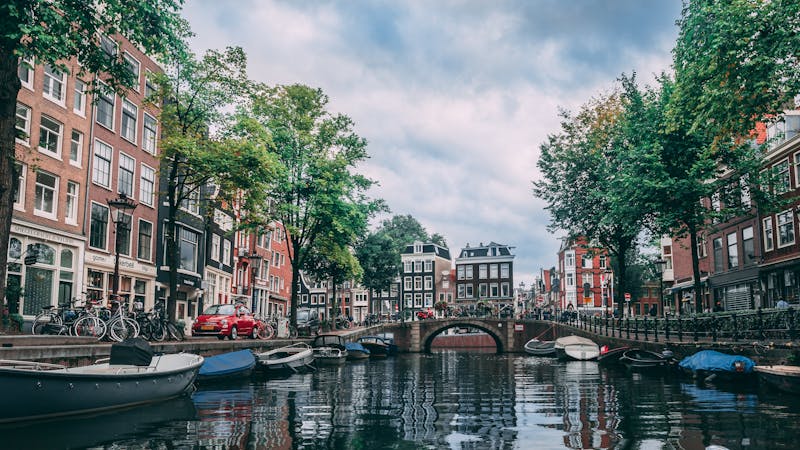
Amsterdam packs seventeenth-century canals, world-class museums and neighbourhoods best explored by bike into a few square kilometres: a compact capital, ideal for a long weekend of art, markets and brown cafés.
Amsterdam is compact: the historic centre, enclosed by the canal belt (Grachtengordel), can be crossed on foot in half an hour, and the bicycle remains the most efficient way to cover everything else. Logistics reward those who book ahead: the Anne Frank House sells tickets online only and they sell out weeks in advance, the Van Gogh Museum requires a timed slot, and the Rijksmuseum swallows half a day. Two days cover the canals, the Jordaan, Museumplein and a cruise; on the third it is worth crossing the IJ on the free ferries to Noord and the former NDSM shipyard. Watch out for the cycle lanes: walking on them is the fastest way to get run over and told off in Dutch.
📜 History at a glance
Amsterdam began as a fishing village at the mouth of the Amstel: a dam across the river — the «dam» that gives the city its name — and a toll exemption granted in 1275 mark its birth certificate. After the revolt against Spain, the seventeenth century became the Golden Age: the Dutch East India Company (VOC), founded in 1602, is considered history's first joint-stock company, and the city dug its belt of three monumental canals — Herengracht, Keizersgracht, Prinsengracht — now a UNESCO World Heritage site. Rembrandt painted The Night Watch here. The Nazi occupation struck the Jewish community, then the largest in the Netherlands, with terrible force: the story of Anne Frank, hidden with her family in a back annexe on the Prinsengracht, remains its best-known testimony. After the war the city became a laboratory of countercultures, from the Provos of the sixties to its policies of tolerance. Today it is the constitutional capital of the Netherlands, even though government and parliament sit in The Hague.
📅 Best time to visit
The best months are April-May — tulips in bloom, Keukenhof open, 12-18°C — and September-October, with golden light on the canals and thinning crowds. Summer is mild (20-25°C, spikes above 30°C are rare) but expensive and extremely crowded, with hotels at peak rates. Winter is dark and damp, 2-8°C, yet between December and January the Amsterdam Light Festival lights up the canals and rates drop by 20-30%. Rain is possible all year round — roughly 130 rainy days — and the North Sea wind makes itself felt: pack a waterproof jacket, umbrellas rarely survive. Avoid King's Day if you want peace and quiet: the city turns into an orange street party of a million people.
Why visit Amsterdam
RijksmuseumVan Gogh MuseumAnne Frank HouseGrachtengordel (canal belt)JordaanDam SquareRoyal PalaceBegijnhofVondelparkDe Pijp and Albert Cuyp marketMuseumpleinWesterkerkNEMO Science MuseumA'DAM Lookoutferries to Noord and NDSMcanal cruise
Rijksmuseum — around €25, the national museum: Rembrandt's Night Watch, Vermeer, applied arts; a solid half day. Van Gogh Museum — around €24, online booking with a timed slot only: 200 paintings, from The Potato Eaters to the Sunflowers. Anne Frank House — around €16, tickets exclusively online, sold out weeks ahead: the secret annexe on the Prinsengracht. Grachtengordel — the seventeenth-century belt of Herengracht, Keizersgracht and Prinsengracht, UNESCO-listed: free on foot, around €18-25 by cruise. Begijnhof — a silent medieval courtyard two minutes from the bustle of Kalverstraat, free entry. Royal Palace on the Dam — around €12.50, the former Golden Age town hall with marble interiors. Westerkerk — the church where Rembrandt lies buried (exact spot unknown), its tower the symbol of the Jordaan. A'DAM Lookout — around €17.50, a panoramic deck across the IJ with a swing 100 metres up. Heineken Experience — around €23, the former brewery: touristy but well done.
Suggested itineraries
1 day: morning on Dam Square, the Begijnhof and a walk through the Grachtengordel; lunch in the Jordaan; afternoon at the Anne Frank House (if booked) and the Westerkerk; canal cruise at sunset; dinner in De Pijp. 2-3 days: day 2 devoted to Museumplein — Rijksmuseum in the morning, Van Gogh Museum in the afternoon, a break in the Vondelpark; day 3 ferry to Noord (A'DAM Lookout, NDSM), back for the Albert Cuyp market and the brown cafés. 5+ days: add the excursions — Zaanse Schans with its windmills (about 20 minutes by train), Haarlem (15 minutes), Utrecht (half an hour), Keukenhof in spring, the villages of Volendam and Marken; a full day also reaches Delft and The Hague with the Girl with a Pearl Earring at the Mauritshuis.
🍽️ Local cuisine
Hearty Dutch cooking plus the Indonesian colonial legacy. Street food: haring (raw herring with onions, €4-5 at the stalls), patat with mayonnaise or oorlog sauce (€4-6), bitterballen (deep-fried ragout balls, made for beer), warm stroopwafels at the markets. Dishes: stamppot (mash with kale and smoked sausage, a winter staple), pannenkoeken (Dutch pancakes, sweet or savoury, €10-15), erwtensoep (thick pea soup). Indonesian rijsttafel: the «rice table» of 10-20 small dishes, €30-45 per person, a colonial inheritance that became a national dish. Cheese: aged Gouda and Edam in the cheese shops, tastings included. Sweets: appeltaart with whipped cream — the one at Winkel 43 in the Jordaan is a ritual — and poffertjes (mini pancakes). The brown cafés, historic bars with smoke-darkened walls, serve beer and simple food; for the modern scene head to the Foodhallen in Oud-West. Beer: Heineken everywhere, but locals drink the craft brews of Brouwerij 't IJ, under the De Gooyer windmill.
Neighbourhoods to explore
Centrum: the Dam, Kalverstraat and the monumental canals; De Wallen (the red-light district) gets rowdy at night. Jordaan: the former working-class quarter turned best-loved neighbourhood — boutiques, minor canals, the Noordermarkt. De Pijp: multicultural and young, the Albert Cuyp market and honest restaurants around Sarphatipark. Museumkwartier/Oud-Zuid: Museumplein, elegant streets, a comfortable and quiet base. Oud-West: lively residential area with the Foodhallen and the Ten Katemarkt. Noord: across the IJ on the free ferries, the NDSM yard, street art, creative warehouses. Plantage/Oost: green, Artis zoo, the botanical garden, fewer tourists. For sleeping: Jordaan and Museumkwartier for charm, De Pijp for value, around Centraal only for transport convenience.
🎭 Events and festivals
27 April: King's Day (Koningsdag), the monarch's birthday — the city dresses in orange, free street markets everywhere, canals packed with boats; book months ahead. Mid-March to mid-May: tulip season, with Keukenhof park at Lisse (about 40 minutes by bus from Schiphol) and the flowering fields of the Bollenstreek. Early August: Pride Amsterdam with the famous Canal Parade on the Prinsengracht. August: Grachtenfestival, classical concerts on pontoons and in courtyards along the canals. October: Amsterdam Dance Event (ADE), the world's biggest electronic music gathering, clubs sold out across the city. Mid-November: Sinterklaas arrives by boat, a family festival. Late November to mid-January: Amsterdam Light Festival, light installations along the canals, best seen from an evening cruise.
How to get there
Schiphol (AMS), 17 km south-west of the centre, is one of Europe's main hubs and KLM's home base. From Italy, KLM, ITA Airways, easyJet, Transavia and Vueling fly direct: from Milan about 1h55 (€50-180 return), from Rome 2h20 (€60-200), from Venice and Bologna about 2 hours, from Naples 2h40 (€70-220). In high season and around King's Day prices double; booking 2-3 months ahead finds low-cost fares under €100. Budget alternative: Eindhoven (EIN), 125 km to the south, served by Ryanair and Transavia with often lower fares, but the train or bus transfer to Amsterdam takes 1h30-2h and costs about €20-25.
🚇 Getting around
From Schiphol to the centre: the NS train reaches Amsterdam Centraal in 15-17 minutes for about €5, with constant departures even at night; alternatively the Airport Express bus 397 to Leidseplein (about €6.50, 30 minutes) or a metered taxi at €50-60. In town the GVB network combines trams, metro, buses and the free ferries across the IJ: pay with a contactless card (OVpay) at about €3.40 per hour, or take a day ticket for about €9 and 2-3-day cards at decreasing rates. The centre, though, is best covered on foot or by bicycle: rental €12-18 per day (MacBike, Yellow Bike), always lock it with two locks. Taxis are expensive and rarely needed; Uber works. Driving is a bad idea: parking runs €7.50 per hour in the centre — better the peripheral P+R lots at about €8 per day with public transport included.
Budget and prices
Return flight from Italy €50-200 in low season, over €250 in high. Sleeping is the heavy item: hostel bed €35-60, central 3-star €130-250 per night, 4-star €200-400, and the room carries a 12.5% tourist tax, the highest in Europe. Airbnbs are restricted and pricey. Meals: broodje or street food €5-10, lunch €12-20, dinner at a mid-range restaurant €25-45 per person, rijsttafel €30-45, draught beer €6-7. Museums: €16-25 each; the I amsterdam City Card (72 hours, about €125) only pays off with 2-3 entries a day — the Van Gogh is included but the Anne Frank House is not. Transport: €10-20 for the whole stay, or a rental bike. Weekend total for a couple (flights excluded): €500-800 in low season, €800-1,300 in high.
📋 Practical info
Currency: euro. Language: Dutch, but practically everyone speaks English. Payments: a nearly cashless society — many venues and supermarkets are card-only (note: some credit networks fail, a debit card is safer). Tap water excellent and free. Sockets type C/F, 230V — standard European plugs work. Tipping: not compulsory; round up or leave 5-10% for good service. EU citizens: an ID card is enough, and roaming carries no extra charges. Local rules: cannabis is tolerated only inside coffeeshops (smoking it on the street is banned in the centre), drinking alcohol on the street is prohibited, and no photos of the windows in De Wallen. Safety is high; pickpockets cluster around Centraal and on the tourist trams. The real hazard: bicycles, which do not brake for distracted pedestrians.
💡 Practical tips
Book the Anne Frank House the moment tickets go online: they vanish within hours.
Buy your stroopwafel warm at the Albert Cuyp market, not pre-packaged.
Use the free ferries behind Centraal: Noord and NDSM are creative Amsterdam without the crowds.
A canal cruise pays off most at sunset or after dark, when the bridges light up.
Appeltaart at Winkel 43 in the Jordaan, on Saturday morning with the Noordermarkt next door.
Never walk on the red cycle lanes.
Hotels too dear? Look at De Pijp and Oud-West, or sleep in Haarlem: 15 minutes by train and lower rates.
A long weekend of 3 days is the right measure: canals and the Jordaan on day one, the great museums on day two, Noord and the markets on day three. With 4-5 days you add the classic excursions — Zaanse Schans, Haarlem, Keukenhof in spring — without rushing.
The NS train is the obvious choice: 15-17 minutes to Amsterdam Centraal for about €5, with very frequent departures even at night. Bus 397 serves the Leidseplein and museum area for about €6.50. A taxi costs €50-60 and is no faster in traffic.
Excluding flights, budget €500-800 in low season and €800-1,300 in high season. The hotel is the dominant cost — €130-250 per night for a 3-star plus the 12.5% tourist tax — while transport barely registers, since everything is covered on foot or by bike.
The Jordaan and the Museumkwartier for atmosphere and quiet, De Pijp and Oud-West for the best value with excellent restaurants, the streets around Centraal only for train convenience. If prices look prohibitive, sleep in Haarlem: a pleasant historic centre just 15 minutes away by train.
Yes, one of Europe's safest capitals, even at night. The real risks are pickpockets in crowded spots — Centraal station, trams 2 and 12, De Wallen — and collisions with cyclists, who assume they always have right of way. Avoid buying any substance on the street: scams are frequent.
Because entry is by online booking only, daily numbers are capped by the fragility of the building, and demand is global. Tickets are released a few weeks in advance and sell out within hours: set a reminder and book before you book your flight.
Try raw herring at the stalls, bitterballen with a beer in a brown café, pannenkoeken and appeltaart with whipped cream. The surprise is Indonesian cuisine: the rijsttafel, dozens of small dishes to share, is the colonial inheritance that became the Dutch national feast.
This site uses third-party cookies — Google Analytics for visit statistics and functional cookies for the flight search engine. By clicking "Accept" you consent to the use of cookies. Cookie policy