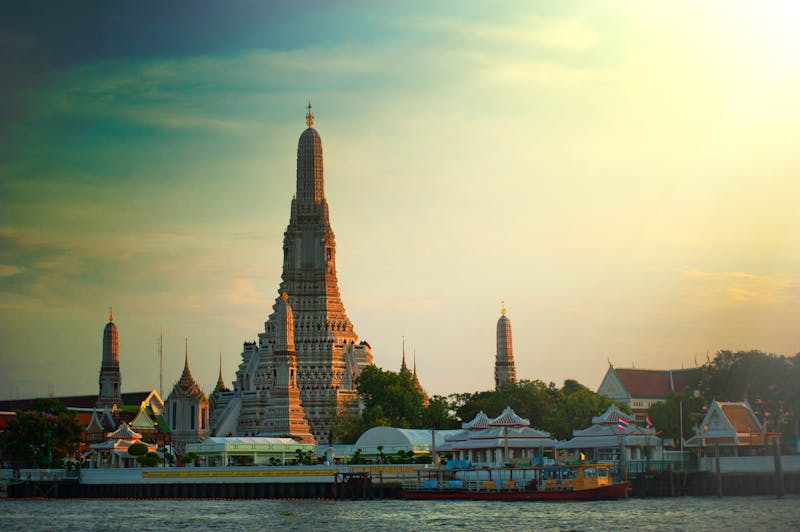
Bangkok is a metropolis of contrasts: gilded temples and skyscrapers, river boats and shopping malls, street food stalls with Michelin recognition. Chaotic, cheap and surprisingly welcoming, it deserves at least three days.
Bangkok is enormous and cannot be explored on foot: the interesting districts lie kilometres apart and the traffic is among the worst in Asia. It pays to think in zones: Rattanakosin, the historic island on the Chao Phraya river, concentrates the Grand Palace, Wat Pho and Wat Arun; Chinatown (Yaowarat) is the kingdom of street food; Sukhumvit and Silom are the modern areas served by the BTS and MRT, with hotels, shopping malls and nightlife. The river and the canals remain genuine transport arteries, often faster than the roads. Three days cover the main temples, a market and a couple of districts; with four or five you can add Chatuchak, the Thonburi canals and a day trip to Ayutthaya.
📜 History at a glance
Bangkok became the capital in 1782, when Rama I, founder of the still-reigning Chakri dynasty, moved the court to the east bank of the Chao Phraya after the destruction of Ayutthaya by the Burmese and the brief Thonburi kingdom. The full ceremonial name — Krung Thep Maha Nakhon plus another twenty-odd words, the longest place name in the world — is shortened to Krung Thep, «city of angels»: Bangkok was originally just the name of a pre-existing village. In the nineteenth century kings Mongkut (Rama IV) and Chulalongkorn (Rama V) modernised Siam with railways, a postal service and reforms, and through skilful diplomacy kept it independent: it is the only country in Southeast Asia never to have been colonised. In 1932 a bloodless coup introduced constitutional monarchy. The city of canals, once nicknamed the «Venice of the East», filled most of them in during the twentieth century to build roads. The economic boom of the eighties and nineties turned it into a vertical megalopolis: today the metropolitan area exceeds ten million inhabitants.
📅 Best time to visit
The best season runs from November to February: it is the cool, dry season, with 25-32°C, clear skies and bearable humidity — and it is also high season, with prices at their peak. From March to May the heat turns fierce: April is the hottest month, often above a real 38°C that feels like far more. From June to October the monsoon dominates: violent but usually short downpours, almost always in the afternoon; September and October are the wettest months, with possible flooding. The rainy season does, however, bring fares 20-40% lower and a less crowded city. In mid-April Songkran, the Thai New Year, turns Bangkok into one gigantic water fight: great fun but chaotic, with many businesses closed.
Grand Palace and Wat Phra Kaew — the royal complex housing the deeply revered Emerald Buddha; entry around ฿500, strict dress code with shoulders and knees covered. Wat Pho — the 46-metre Reclining Buddha and the country's oldest school of traditional massage; around ฿300. Wat Arun — the porcelain-clad «Temple of Dawn» on the Thonburi bank, best photographed at sunset from the opposite shore; around ฿200. Wat Saket (Golden Mount) — a gilded chedi on an artificial hill with a 360° view over the old city; around ฿100. Wat Traimit — in Chinatown, home to a solid gold Buddha weighing 5.5 tonnes. Jim Thompson House — the teak home of the American who revived Thai silk, a green oasis in the city centre; around ฿200. Chatuchak Market — over 10,000 stalls, Saturdays and Sundays only, from vintage to antiques. Khao San Road — the historic backpacker street of bars, pad thai and fried insects.
Suggested itineraries
1 day: early morning at the Grand Palace and Wat Phra Kaew (before the heat and the tour groups), then Wat Pho; ferry across to Wat Arun; afternoon on a Chao Phraya boat and evening in Chinatown for street food. 2-3 days: to the first day's programme add Jim Thompson House, shopping between Siam and Sukhumvit, a Thai massage, a rooftop bar at sunset and — at the weekend — Chatuchak market; in the evening night markets such as Jodd Fairs. 5+ days: a day trip to Ayutthaya (the ruins of the old capital, by train or minivan, 1.5-2 hours), the Damnoen Saduak floating market or the Maeklong railway market, the Thonburi canals by longtail boat, and perhaps two days at the seaside in Hua Hin or Pattaya.
🍽️ Local cuisine
Bangkok's cuisine lives on the streets and in the markets. Signature dishes: pad thai (stir-fried noodles, born right here), tom yum kung (spicy prawn soup), som tam (green papaya salad), green curry and massaman curry, khao man gai (chicken rice), boat noodles. Street food: a portion costs ฿50-80; Chinatown (Yaowarat) in the evening is the most famous address, along with the alleys of Bang Rak and the night markets. The Michelin guide has honoured the stalls for years: Jay Fai, with her crab omelette, holds a star. Food courts in the shopping malls (Terminal 21, MBK): clean, air-conditioned, ฿60-120 a dish. Desserts: mango sticky rice (glutinous rice with mango, at its best between April and June), banana roti. Worth knowing: the spice is real — ask for «pet nit noi» (only slightly spicy); in restaurants the ice is industrially made and safe. Dinner in a mid-range restaurant runs ฿300-600 per person.
Neighbourhoods to explore
Rattanakosin: the historic island with the Grand Palace, Wat Pho and the national museums; no metro nearby, so arrive by river boat. Banglamphu / Khao San: the backpacker quarter, cheap guesthouses and shoestring nightlife. Chinatown (Yaowarat): neon signs, gold shops and the best street food in the city; served by the MRT. Sukhumvit: modern Bangkok along the BTS — hotels in every bracket, shopping malls, nightlife in Thonglor and Ekkamai. Silom / Sathorn: the business district with Lumphini Park and the rooftop bars. Riverside: the luxury hotels overlooking the Chao Phraya and the IconSiam mall. Ari: residential and fashionable, cafés and local cooking far from the tourist circuits.
🎭 Events and festivals
Songkran (13-15 April): the Thai New Year, three days of water battles across the whole city, with Khao San Road and Silom as the epicentres. Loy Krathong (November full moon): little baskets of banana leaves and candles set afloat, spectacular on the Chao Phraya and on the ponds of Lumphini Park. Chinese New Year (between January and February): Yaowarat fills with dragons, drums and stalls. Vegetarian Festival (between September and October): nine days of plant-based cooking in Chinatown, recognisable by the yellow flags. The King's Birthday (28 July) and Father's Day (5 December): illuminated public buildings and ceremonies. Between December and January the Siam malls put up spectacular light displays; the busiest New Year countdown is outside CentralWorld.
How to get there
Bangkok has two airports. Suvarnabhumi (BKK), about 30 km east of the centre, is the main hub and receives the intercontinental flights: from Italy, Thai Airways links Milan Malpensa with a direct flight of around 11 hours, while from Rome, Milan and Venice you fly with one stop — Qatar Airways via Doha, Emirates via Dubai, Turkish Airlines via Istanbul, Etihad via Abu Dhabi — in 13-17 hours overall. Return fares run roughly €500-800, above €900 around Christmas and in August. Don Mueang (DMK), about 25 km north, is the base of Asia's low-cost carriers (AirAsia, Thai Lion Air, Nok Air): it has no flights from Italy, but is extremely useful for continuing to Chiang Mai, Phuket, Krabi or the neighbouring capitals, with domestic flights often at ฿700-1,500.
🚇 Getting around
The traffic is legendary: better to travel by rail and by water. The BTS Skytrain (Sukhumvit and Silom lines) and the MRT (Blue Line) cover the modern city, rides at ฿16-62; the rechargeable Rabbit card skips the BTS queues. Chao Phraya Express Boat: scheduled river boats at ฿16-30 with piers close to the temples; the khlong boats on the Saen Saep canal cut through the traffic towards Jim Thompson House. Taxis: meter from ฿35, insist it is switched on; the Grab app is the most convenient alternative. The tuk-tuk is worth it as an experience, with the price agreed before boarding. From Suvarnabhumi: the Airport Rail Link to Phaya Thai (BTS interchange) in about 30 minutes for ฿45; taxi ฿400-500 including tolls, 45-70 minutes. From Don Mueang: A1/A2 buses to Mo Chit BTS or Dark Red Line trains (฿30-35); taxi ฿300-400.
Budget and prices
Bangkok remains cheap by European standards. Sleeping: hostel bed ฿300-600; 3-star hotel ฿1,000-2,000 (around €30-55); 4-star ฿2,000-4,000; the famous 5-star riverside hotels, among the best in the world, ฿7,000-15,000 — less than a good European 4-star. Eating: street food meal ฿50-100, food court ฿60-120, mid-range restaurant ฿300-600 per head, rooftop cocktail ฿300-500. Getting around: BTS/MRT ฿16-62 a ride, river boat ฿16-30, Grab rides in town ฿100-250. Entrance fees: the great temples ฿100-500, many minor wats free. Daily budget: €25-40 per person backpacker-style, €60-100 mid-range with a 4-star hotel, massages and the odd restaurant; luxury costs roughly half what it does in Europe. Traditional Thai massage: ฿300-500 an hour.
📋 Practical info
Currency: Thai baht (THB, ฿), indicative rate €1 ≈ ฿37-40. The language is Thai; English works in hotels and tourist areas, less so with taxi drivers. Sockets: 220V, hybrid outlets that accept two-pin European plugs; an adapter is rarely needed. Tap water: not drinkable, bottles everywhere at ฿10-20. Safety: a calm city for tourists; watch for pickpockets in crowded markets and the classic scams («the temple is closed today», gem shops, almost-free tuk-tuks). Tipping: not compulsory; round up or leave ฿20-50. SIM/eSIM: tourist packages from AIS, True and dtac at the airport for ฿300-600 with generous data. Visas: EU citizens enter visa-free for short tourist stays (currently up to 60 days); passport valid for at least 6 months. Absolute respect for the monarchy and for monks.
💡 Practical tips
Temples require covered shoulders and knees: carry a scarf or light trousers and shoes that slip off easily.
Ignore anyone telling you the Grand Palace «is closed today»: it is the oldest scam in the city.
Taxis only with the meter running, or use Grab: haggling is for tuk-tuks only.
The Chao Phraya boat is the loveliest and cheapest way to move between the temples.
Chatuchak opens only on Saturdays and Sundays: go in the morning, before the heat wins.
Mango sticky rice is at its best between April and June.
Enter the Grand Palace at opening time: by mid-morning the tour groups arrive.
Three full days cover the main temples, Chinatown, a market and a rooftop bar: that is the sensible minimum. With four or five you can add Chatuchak, the Thonburi canals and a trip to Ayutthaya. Many use it as a stage of a wider Thailand trip: in that case 2-3 days on arrival plus one before flying home works well.
From November to February: the dry, «cool» season (25-32°C), the most pleasant weather of the year, but also the highest prices. From March to May the heat is scorching, with April above 38°C. From June to October come the monsoons: short downpours almost every afternoon, lower fares and fewer crowds — a compromise many travellers happily accept.
Yes, violent crime against tourists is rare. The real risks are pickpockets in crowded markets, organised scams (almost-free tuk-tuks, «the temple is closed», gem shops) and the traffic: cross roads with care. Avoid any comment about the monarchy, protected by extremely strict laws, and be wary of bets or games proposed by strangers.
From Suvarnabhumi (BKK) the Airport Rail Link reaches Phaya Thai, an interchange with the BTS, in about 30 minutes for ฿45; a metered taxi costs ฿400-500 and takes 45-70 minutes depending on traffic. From Don Mueang (DMK) the A1/A2 buses run to Mo Chit BTS along with Dark Red Line trains; a taxi costs around ฿300-400.
Sukhumvit (BTS stops between Nana and Ekkamai) for convenience, hotels in every bracket and nightlife; Silom/Sathorn for the balance of metro, park and rooftops; Riverside for the five-star hotels overlooking the river; Banglamphu/Khao San for low budgets and backpacker atmosphere, accepting the lack of a metro. The decisive criterion is staying near a BTS or MRT station.
Generally yes: choose stalls crowded with local customers, with fast turnover and dishes cooked to order in front of you. Industrial ice, recognisable by the hole through the middle, is safe. Be cautious with raw seafood in the hottest hours. A European stomach may need a couple of days to adapt to genuinely spicy food.
Excluding flights, a couple spends roughly €700-1,000 at mid-range level: a 3-4 star hotel at ฿1,500-3,500 a night, meals split between street food and restaurants at ฿600-1,500 a day for two, with very modest transport and entrance costs. Backpacker-style, €300-450 per couple is enough; with a five-star hotel on the river you pass €2,000.
This site uses third-party cookies — Google Analytics for visit statistics and functional cookies for the flight search engine. By clicking "Accept" you consent to the use of cookies. Cookie policy